Generative AI in publications development: Innovation with oversight

Abstract image of different shaped holes in building

Balancing technological advancement with scientific integrity

At Acumetis, we recognize that generative artificial intelligence (AI) is increasingly shaping the future of medical publication development. Insights discussed at ISMPP 2025 underscored both the promise of AI to improve efficiency and consistency, and the continued necessity of rigorous human oversight to protect scientific quality and credibility. While AI can meaningfully support publication teams, expert judgment remains essential for peer‑reviewed scientific work.

Current best practices in AI-enhanced publication development

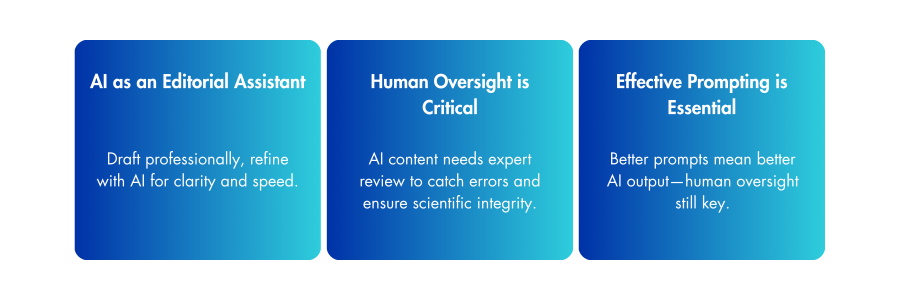
AI as an editorial assistant

A practical and responsible approach positions AI as a support tool rather than an author. Publication development begins with a draft created by an experienced medical publication professional, followed by the use of AI to improve readability, grammar, and flow. This hybrid model balances efficiency gains with accuracy and accountability.

Human oversight is critical

AI-generated content must be thoroughly reviewed to identify hallucinations, inaccuracies, or unintended tone shifts. To maintain scientific and ethical standards, a qualified medical writer must validate all outputs.

Effective prompting is essential

The emerging field of prompt engineering highlights the importance of well-crafted inputs to guide AI tools. This approach helps generate higher-quality outputs that reduce the time needed for human validation. Promising models—such as smart, adaptive interfaces that simplify complex tasks through guided questioning, or dual-agent systems where one AI prompts and another generates—offer exciting potential but still require human oversight and refinement.

Ethical and legal considerations

Many generative AI tools are trained on previously published content. It is crucial to ensure that any material used as part of generative AI inputs carries appropriate copyright licenses, such as CC-BY, which allows users to exercise rights as an author, if the work is cited. For additional information see ISMPP’s checklist.

We advise prioritizing the use of this checklist early in the publication development process and completing during project initiation. This ensures a rigorous evaluation of generative AI’s appropriateness and establishes clear guidelines for its responsible and effective application.

Disclosure requirements

Transparency is critical. Disclosing AI involvement in the development of manuscripts is becoming a standard practice—and, increasingly, a requirement for submission to journals and congresses.

Upholding standards in an evolving landscape

As generative AI becomes more deeply embedded in scientific communications, the conversation is shifting from novelty to responsible integration. Acumetis believes the future of medical publishing will be defined by thoughtful adoption of new technologies paired with unwavering commitment to rigor, transparency, and trust. Innovation can accelerate progress—but only when guided by experienced professionals who safeguard scientific integrity at every stage.

About Acumetis medical affairs team

Acumetis Medical Affairs partners with biopharma teams to know the science and own the narrative, turning scientific strategy, evidence generation, and medical communications into credible stories that shape decisions and build confidence. Our teams bring deep therapeutic and rare disease expertise, combining scientific rigor with practical judgment to ensure publications meet the highest standards of quality, compliance, and impact.
By anticipating evidence needs early and translating complex data into clear, compelling narratives, we help organizations build trust with HCPs, payers, and patients, while responsibly integrating innovation into medical publication development.
To learn how Acumetis Medical Affairs can support your publications strategy, contact us to start the conversation.

Request a Consultation

Our experts can help you reframe what’s possible. 

Let's Talk

"*" indicates required fields

Learn More

Meet the Experts:

Chris Zealey
Chris Zealey
Partner

Chris has close to a decade of experience in medical strategy and strategic communications, with expertise in developing strategic scientific narratives and communication resources, cross-functional and medical strategy, stakeholder engagement and insight generation. His focus is serving as a strategic and scientific partner to organizations launching new therapies or entering new disease areas. Recently, his work has focused on various rare disease indication launches and in-line therapy strategic planning.

Patrick Hillan
Patrick Hillan
Partner

Patrick Hillan has spent more than a decade working alongside Medical Affairs teams to shape medical strategy and enable meaningful engagement with HCPs through the design and facilitation of Medical Advisory Boards and Strategic Working Groups. He has experience across multiple therapeutic areas, with a particular focus on psychiatry and neurology, and has supported pre-launch Medical Affairs activities for therapies in Major Depressive Disorder, Postpartum Depression, Schizophrenia, Parkinson’s disease, Angelman syndrome, muscular dystrophies, and Alzheimer’s disease.

FAQs on generative AI in medical publications

1. How can generative AI support medical publications without compromising scientific integrity?

Generative AI can improve efficiency and consistency when used as an assistive tool and paired with rigorous review by experienced medical publications professionals.

2. What role does human oversight play in AI‑enabled publication development?

Human oversight ensures scientific accuracy, appropriate interpretation, ethical compliance, and accountability for all published content.

3. How does Acumetis approach the responsible use of AI in publications?

Acumetis integrates AI thoughtfully within established Medical Affairs workflows, ensuring transparency, compliance, and preservation of scientific rigor.

4. When is generative AI most valuable in the publications process?

AI is most effective after expert‑led drafting, where it can support refinement of clarity, structure, and readability.