Ready to move from patient voice to action?
Explore how patient and advocate insights can help strengthen decisions across development, launch, access, support, and engagement.

Patient voice is what patients, caregivers, care partners, and advocates share about their experiences, needs, barriers, and expectations.
Patient insight is what happens when that input is translated into action.
Most pharma and biotech organizations are already engaging patients and advocacy partners in some way. They may be convening advisory boards, hosting patient summits, conducting interviews, gathering survey feedback, testing messages, or partnering with advocacy organizations. These activities create valuable opportunities to hear directly from the people they are trying to serve.
But listening is only part of the job. The more important question is what happens with that input once it has been gathered.
Patient and advocate perspectives can help teams identify problems earlier, challenge assumptions, and make programs and communications more relevant. They can shape clinical trial communications, launch planning, patient support, market access, education, and external engagement.
As Kevin Asher, Medical Practice Lead at Acumetis, explains:
“At Acumetis, we believe patient voice should not sit at the margins of strategy. It should help shape it.”
The challenge is making sure that voice reaches the people making the decisions.
Patient engagement is now common across pharma and biotech. The harder part is showing that the input made a difference.
Patients and advocates often participate because they want sharing their experience to improve something for others. They may be sharing barriers to treatment, frustrations with the healthcare system, emotional reactions, or lessons learned from living with a disease.
Naturally, they want to know what happened next.
Did their feedback make trial language easier to understand? Did it uncover an access barrier? Did it change an educational resource or help a team rethink part of a launch plan?
Not every recommendation will be adopted. But people want to know that their time and experience were taken seriously.
When that connection is missing, engagement can start to feel transactional. A company may leave an advisory board with pages of notes, while participants have no idea whether anything will change. Feedback on recruitment materials may never reach the team responsible for enrollment. An advocacy organization may raise a communications concern that never gets shared beyond the group running the engagement.
Over time, those gaps can make patients and advocates question whether participating is worth the effort.
Patient input is most useful before major decisions have been made.
Too often, patients and advocates are brought in after a protocol, strategy, communication, or launch plan is already well underway. By then, the conversation can become more about validating the work than shaping it.
That timing can lead to practical problems. A recruitment campaign may not reflect the people it is trying to reach. Trial information may use language that makes sense internally but is confusing to patients and families. A marketing concept may miss the emotional reality of a disease. A launch plan may overlook an educational need, access barrier, or trust issue that an advocate could have identified earlier.
The problem is not always that the organization failed to listen. It may be that the organization listened too late or the insight did not travel far enough internally.
Patient input should help shape decisions while there is still time to change them.
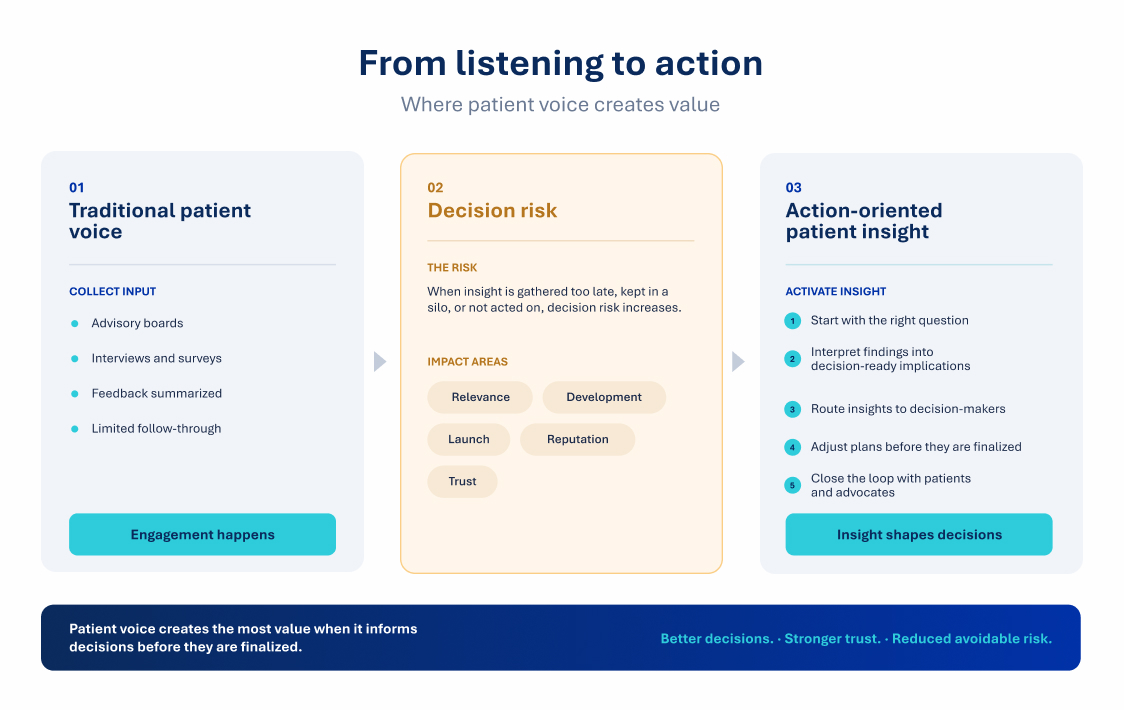
Patient voice creates the most value when it moves beyond documentation and becomes part of how teams make, pressure-test, and refine decisions.
AI can support early exploration. It should not replace real patient representation.
AI is becoming part of how organizations develop content, explore ideas, and work more efficiently. That can be useful. But speed does not matter if the result does not feel credible to the people it is meant for.
Patients want to see real experiences reflected in the materials and programs intended for them. They do not want to be reduced to personas or generalized profiles.
When companies rely too heavily on synthetic imagery or assumptions about a patient population, they risk appearing disconnected from the community they are trying to reach.
AI can support the process. It should not replace direct patient involvement.
Patient engagement works better when teams are clear about what they need to learn before the conversation starts.
Before an advisory board, patient summit, interview, material review, or working session, teams should ask:
These questions help keep valuable feedback from sitting in a meeting summary or staying within one function.
A concern raised by a patient may have implications for clinical development, recruitment, patient support, commercial strategy, education, communications, or market access. The more effectively those insights are shared, the more useful they become.
Better patient engagement is not about implementing every suggestion. It is about being clear on how patient input will be used.
That starts with bringing patients and advocates into the process earlier. It also means involving the teams that may need to act on what they hear.
After the engagement, the most important insights should be shared with the right people, not left buried in a report. Companies should also close the loop with participants by explaining what was heard, what changed, what is still being considered, and what could not change.
Done well, patient engagement can help teams avoid preventable mistakes, develop more relevant materials, identify barriers earlier, and build stronger relationships with patient communities.
The goal is not simply to listen better. It is to make better decisions because you listened.
The next step for pharma and biotech is not necessarily to create more patient engagement activities. It is to make better use of the insight already being gathered and show patients and advocates that their participation had a purpose.
Ready to move from patient voice to action?
Read the full Acumetis white paper to explore how patient and advocate insights can help reduce decision risk, improve cross-functional planning, and build stronger relationships with patient communities.
"*" indicates required fields
Explore how patient and advocate insights can help strengthen decisions across development, launch, access, support, and engagement.