Request a Consultation
Our experts can help you reframe what’s possible.

Here’s an uncomfortable question for access leaders: if your access function disappeared tomorrow, how long would it take your organization to notice?
If the honest answer is “at the time of the next HTA submission,” access is still being run as a service to the business rather than a driver of it. If the answer is “immediately, because launch, pricing and development decisions would stall,” the organization has built something worth protecting. Most access functions likely sit somewhere in between.
The gap between those two answers is widening, and it has less to do with talent than with how teams are built. Consider a scenario that plays out across the industry in one form or another.
A biotech with a promising innovation is perhaps eighteen months from launching its first rare disease asset. The US team has modeled a launch price it is genuinely pleased with: defensible, competitive and comfortably within what payers have accepted for comparable therapies. On another continent, the European access lead is preparing for a Joint Clinical Assessment. Somewhere in between, the HEOR team is finalizing an evidence plan built around the comparator the US label strategy assumes.
Nobody in that picture is doing anything wrong. Each team is good at its job and doing exactly what its role asks of it. But they are all, very competently, walking toward a problem nobody owns.
That US price will become the yardstick everything else is measured against. JCA scoping will almost certainly bring in comparators the evidence plan never anticipated. And the order in which the company launches will quietly shape the price it can achieve in each market—and the ultimate value of the asset.
The decisions that matter most are sitting in the gaps between teams.
In a company like that, access would be missed at the next submission, not in the immediacy of the next big decision. That isn’t because the people aren’t doing a great job. It’s because of how the function was built.
Over the past several decades, Market Access has grown from a niche specialism called in late to something no serious launch plan starts without. But the way many access functions are organized hasn’t always evolved at the same pace.
They were built for a sequential world. A product launched in the US, then the larger European markets, then everywhere else, with each country conducting its own negotiation. Organizations structured themselves accordingly. Global set the value story and affiliates adapted it. HEOR built the models, pricing set the corridors, and policy watched the horizon.
At the time, it was the right answer. It isn’t anymore.
Market Access is no longer a series of local negotiations. It’s one interconnected system, where a decision taken in Boston or Basel can set the terms in Berlin, Madrid and Tokyo. Yet many access teams aren’t built to manage a system. They’re built to manage their individual part of it.
Europe. Joint Clinical Assessment consolidates member states’ requirements into a single scoping exercise, often producing a far longer list of populations and comparators than any one country would ask for—or than anyone expected. It happens close to regulatory submission, when the evidence an organization will be judged on is largely locked in. If the evidence plan was built around one market’s view of the world, JCA is where the gaps in those choices become apparent, publicly and all at once.
The United States. European teams could once treat the US as a separate universe. Not anymore. The Inflation Reduction Act has changed how companies think about which indications to pursue and in what order, and policy momentum toward linking US prices to those paid elsewhere means a European price can now echo back across the Atlantic. Companies are already rethinking whether, when and at what price to launch in some European markets. Launch sequencing used to be a planning question. It is now one of the most consequential strategic decisions an access leader can influence.
Evidence itself. Real-world data, more sophisticated indirect comparisons and AI-enabled evidence synthesis are changing what’s possible, and payers’ expectations with them. The effect is to push organizations toward one global evidence strategy, designed early and used everywhere. That only works if someone is holding the whole picture and adjusting nimbly as it changes.
Each force takes something that used to be decided locally, sequentially or late and makes it global, simultaneous and early.
What does this mean for capability? The skills required aren’t necessarily new; they are differently weighted.
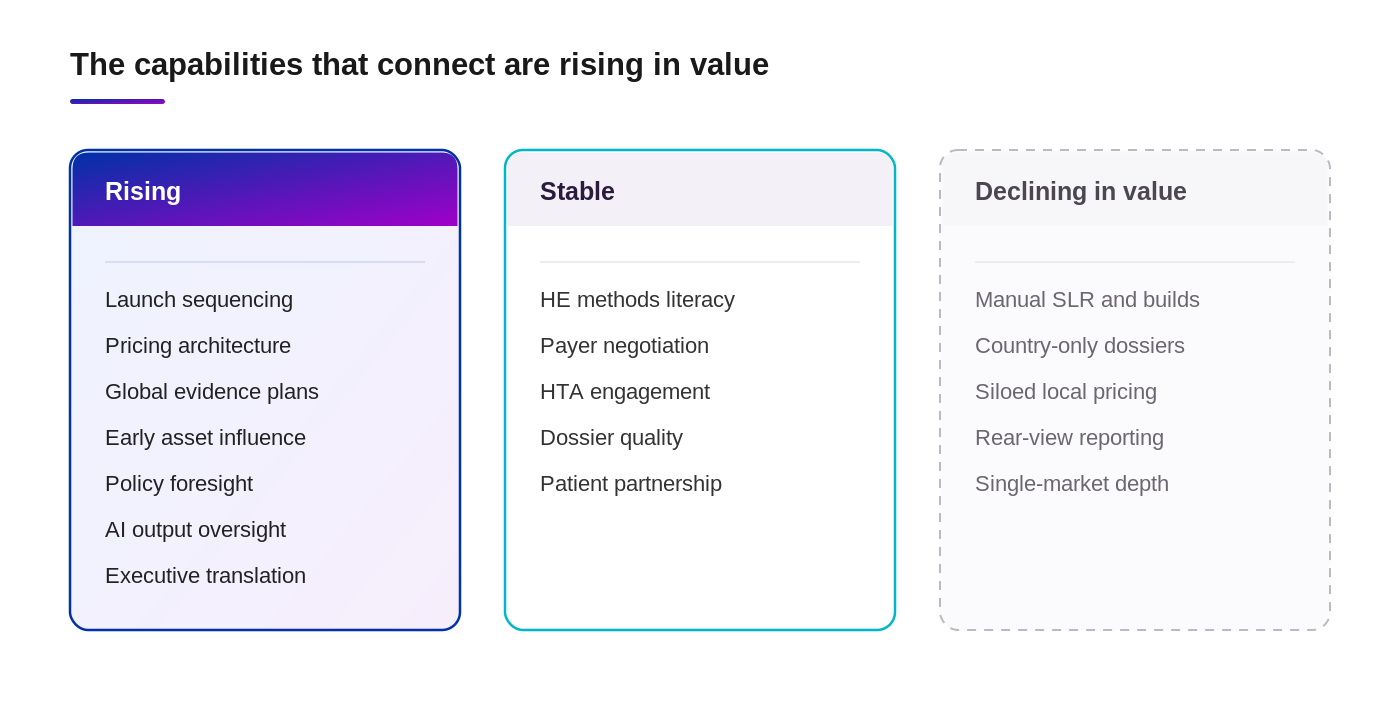
Almost everything rising in importance is about connection: linking markets to each other, access to development, and today’s decisions to tomorrow’s constraints.
Overseeing AI outputs belongs there too. As production is automated, the value shifts to those who know what to ask for and whether a payer will accept the answer.
Then there’s executive translation. Access leaders with the most influence aren’t always the most technically brilliant. They’re the ones who can explain an access risk—and opportunity—in the language a board or executive team acts on.
The foundational capabilities remain essential; without them, none of the connective work holds up. Other capabilities still matter, and someone still has to do them well. But on their own, in one market, for one function, they’re no longer where a team sets itself apart.
None of these calls for a wholesale reorganization. For organizations that want the answer to the opening question to be “immediately,” a few deliberate moves can make a difference. These are mostly about where decisions sit rather than what the organizational chart looks like.
Give the gaps an owner, early. The problem in the opening scenario wasn’t a lack of expertise. It was that nobody owned the question: “If we do this here now, what does it cost us there later?” That might mean a global launch council with real decision rights or one senior access leader with a broader mandate. Either way, the question needs a home years before launch, and access needs a genuine seat at the table when target product profiles, trial designs and indication sequences are decided, not after.
Redraw the deal between global and affiliates. The most valuable thing an affiliate brings now is early intelligence: what its payers and HTA bodies will ask for and where the evidence will be challenged. That needs to flow into the global evidence plan at the start, not arrive as feedback at the end.
Be deliberate about what stays in-house. Judgment-heavy, connective work should remain close to the leadership team; it depends on context and relationships that are difficult to outsource. Execution, especially as AI changes its economics, can often be partnered effectively. The mistake is doing the reverse: outsourcing the thinking while keeping all the doing. Organizations should also seek experts who will challenge their thinking rather than simply agree, helping avoid group think and creating opportunities to make better decisions.
Hire and grow for range. The people most valuable to an access team today can move between worlds: an economist who understands pricing politics, or an affiliate lead who has spent time in global strategy. Rotations and cross-functional projects can build this range more effectively than a training course alone. Organizations should also invest in executive translation for senior leaders. It can be the difference between being consulted and being the architect of a decision.
What would the integrated version of the opening scenario look like?
A single conversation, perhaps three years earlier, with US, European, HEOR and development voices in the same room. A US price set knowing how it would echo through every other market. An evidence plan built for the comparators JCA was likely to bring, rather than discovering them at scoping. A launch sequence chosen, not defaulted to. Nobody in that room would need to be smarter than the people in the original scenario. They’d simply be better connected.
That’s the shift that may matter most for the profession over the next five years: less about new skills and more about the connective tissue between the ones access teams already have.
So, if your access function disappeared tomorrow, who would notice, and when?
If the answer isn’t clear, these are the questions leaders should start with:
Who owns cross-market pricing and launch-sequencing trade-offs today, by name?
When did access last change a development decision, rather than respond to one?
How early does affiliate insight reach the global evidence plan?
Could the organization’s most senior access leader explain its biggest access risk to the board in an elevator in a way that changes what the board does next?
The companies that move from “at the next submission” to “immediately” first won’t just launch better. They’ll decide better, years earlier, and the rest of the industry will spend the next decade trying to catch up.
Which answer would your organization give today, and what would it take to move?
Get in touch with Esther Nzenza, Senior Partner and Practice Lead, Global Value and Access, to learn more.
Our experts can help you reframe what’s possible.