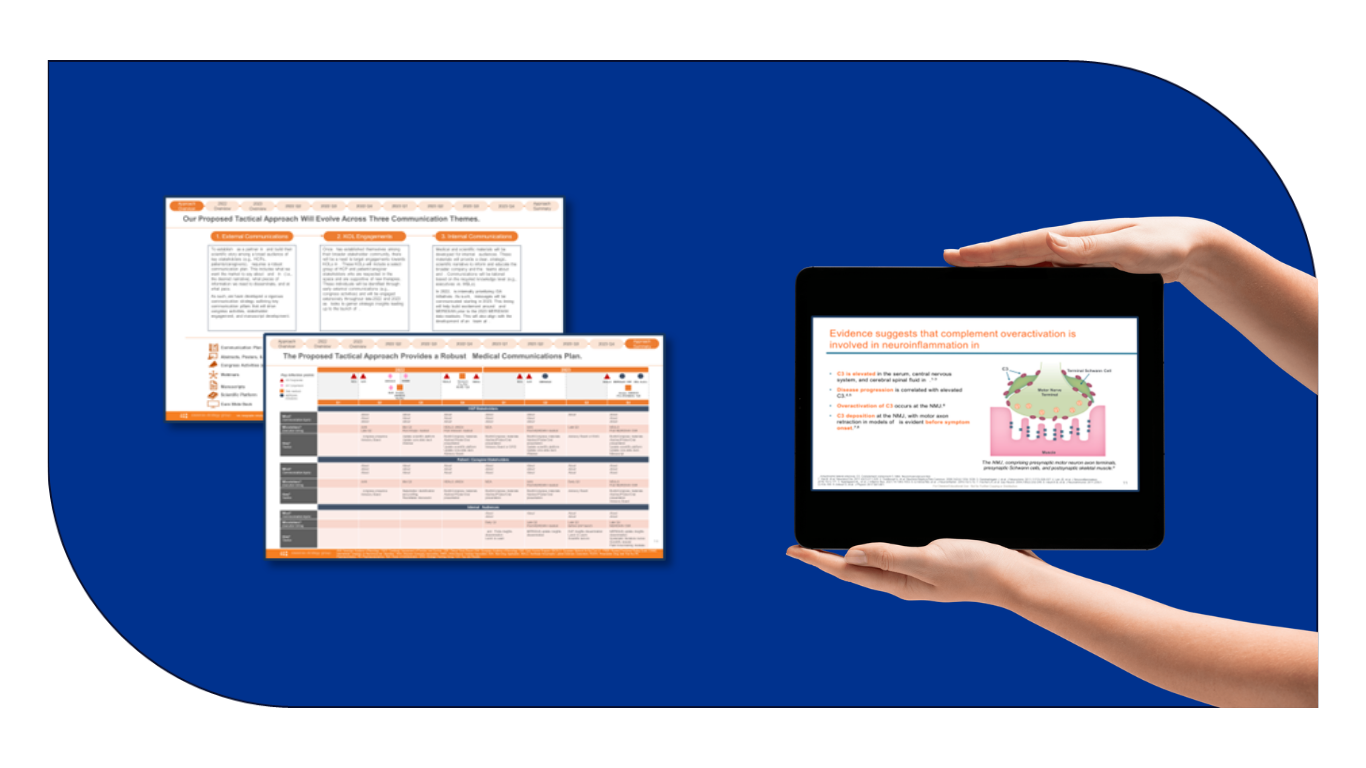
Communication strategy for novel MOA in neurological disorder

Optimizing communication strategies for stakeholder and scientific alignment

Our client had a molecule recognized for its efficacy in reducing innate immunogenicity, previously applied in other therapeutic areas. They sought to extend its application to a degenerative neurological disorder, which posed a significant departure from their established therapeutic areas.

The challenge

The client faced significant challenges in advancing their molecule’s clinical development for a degenerative neurological disorder due to limited data and scientific support for their unconventional therapeutic approach. In this context, they needed to identify the most efficient and cost‑effective strategy to communicate scientific rationale, engage stakeholders, and support program advancement.

Our solution

  1. Created a high-level narrative aligning the MOA with the new indication, leveraging data and aspirational statements to guide evidence generation.
  2. A communication strategy was developed, focusing on the evolution of the desired narrative over time pre- and post-data readout.
  3. High ROI activities were identified, which required strong academic KOL engagement and focused congress presentations.
  4. Advisory boards were organized with experts on disease pathophysiology and the relevance of the MOA. We identified critical biomarkers for investigation and publication to bolster the communication strategy.
  5. Key abstracts and posters were prepared for priority regional congresses, offering a cost-effective method to disseminate information to key stakeholders.

Value delivered

The approach enabled refined scientific communication through structured KOL engagement, targeted congress activity, and iterative feedback. By aligning stakeholder expectations with the evolving evidence base, the strategy strengthened scientific credibility, supported confident decision‑making, and maintained development momentum as the program advanced.

Our medical affairs expertise played a central role in shaping credible scientific dialogue and guiding evidence‑led communication. Our leaders help to bring perspective, challenge assumptions, and ensure continuity as scientific understanding evolves. We help reframe what’s possible in how novel mechanisms are positioned, understood, and communicated, supporting confident engagement with external stakeholders under conditions of uncertainty.

Transform your market approach

We can help your team build a comprehensive communication strategy today.

Learn more

"*" indicates required fields

Learn More

Meet the Experts:

Chris Zealey
Chris Zealey
Partner, Medical Affairs

Chris has close to a decade of experience in medical strategy and strategic communications, with expertise in developing strategic scientific narratives and communication resources, cross-functional and medical strategy, stakeholder engagement and insight generation. His focus is serving as a strategic and scientific partner to organizations launching new therapies or entering new disease areas. Recently, his work has focused on various rare disease indication launches and in-line therapy strategic planning.

FAQs on scientific communication

Why was a tailored communication strategy critical?

The novel application of the MOA required careful scientific framing to establish credibility and align expectations across stakeholders.

How did early narrative development support evidence planning?

Early clarity helped guide evidence priorities, biomarker selection, and consistency across scientific communications.

What role did KOL engagement play?

Academic KOL input validated scientific assumptions and strengthened confidence in the evolving narrative.

Why were congress activities important?

Targeted abstracts and posters enabled efficient dissemination, feedback, and awareness within the neurological research community.