Ready to move from patient voice to action?
Explore how patient and advocate insights can help strengthen decisions across development, launch, access, support, and engagement.

A practical operating model for moving patient and advocate feedback from engagement summaries into action across the enterprise.
Pharma and biotech companies can operationalize patient insights by connecting each engagement to a specific decision, involving the functions that need the findings, and assigning responsibility for follow-through. The Voice to Action Operating Model provides six steps: start with the decision, identify the functions, involve them in planning, translate feedback, route insights back, and document what changed.
An advisory board can surface confusing trial language, education gaps, or difficulties navigating treatment. But when those findings stay with the team that gathered them, related decisions can move forward without that perspective.
A practical operating model gives patient and advocate feedback a clear route into planning, with accountability for how it is considered and communicated back.
Before planning an engagement, define what the organization needs to decide and how patient input could help.
“Understand the patient journey” is a useful ambition, but it may be too broad to guide a focused discussion. More specific questions give participants and internal teams a clearer purpose:
Identify the decision owner and the planning milestone the feedback needs to inform. This helps establish when the engagement should happen and what questions it should explore.
Leave room for unexpected findings. Patients and advocates may raise an issue that changes the team’s understanding of the problem. A focused discussion should make space for those perspectives.
One patient experience can have implications for several teams.
For example, uncertainty about what happens between receiving a prescription and starting treatment could inform patient education, access planning, support services, and launch readiness. Each function needs to understand a different part of that experience.
Before the engagement, identify which teams could use the findings and what decisions they need to make. Patient insight can help:
Clinical Development, Clinical Operations, Medical Affairs, and Corporate Communications may also need to be involved, depending on the decision.
Patient Advocacy and Engagement teams can serve as important connectors. They bring relationships with patient communities, an understanding of community priorities, and experience designing meaningful engagements. Their role is to help insight reach the appropriate decision points. Accountability for acting on it belongs with the relevant functions.
Bring the functions that will use the findings into planning before the engagement takes place. Agree on what they need to understand, which assumptions patients and advocates can help explore, and how the discussion can build on insights already gathered.
Patient Advocacy and Medical Affairs bring complementary perspectives to this work. Patient Advocacy understands community priorities and the relationships behind the engagement. Medical Affairs can help frame questions about disease experience, education needs, and evidence, and interpret the feedback in its scientific and medical context. Working together helps ensure the discussion addresses relevant business questions while giving participants space to raise what matters to them.
Participants should also understand how their input may be used. Explain which decisions are open to influence and where there are limits on what can change. That clarity respects their time and makes it easier to return with a meaningful update after the engagement.
A summary captures what participants said. To support a decision, teams also need to understand why the feedback matters and what requires attention.
Consider this illustrative example:
What was heard: Patients described uncertainty about whom to contact when treatment initiation was delayed.
What it may mean: Guidance may be unclear at a point when patients need practical help.
What the team should consider: Review whether onboarding materials explain the next steps, available assistance, and whom to contact.
This translation makes the feedback useful without assuming the solution in advance. The next step may be a change to a resource, a review of an existing process, or further investigation.
Preserve the context behind the finding. An individual experience, a recurring theme, and an unresolved question carry different implications. Teams should understand whose perspectives were represented, where participants disagreed, and what remains uncertain.
Sending a report to multiple functions does not establish who will respond.
For each priority insight, identify an owner, the decision it could affect, and a timeframe for review. If several functions are involved, clarify who will coordinate the response.
The receiving team should assess whether the finding warrants a change, further exploration, or no action at present. Patient Advocacy can help preserve the meaning of the feedback as that assessment takes place, while Medical Affairs can support interpretation where scientific or medical context is needed.
Use existing planning meetings and review processes wherever possible. Bringing patient insight into launch reviews, evidence discussions, or support program planning makes it part of the work already underway.
Record how the organization responded. That might include revised trial communications, clearer education, an adjustment to patient support, or a new question for the evidence plan.
Where a recommendation cannot be implemented, capture the reason. Where further review is needed, identify the next step.
Then plan how to communicate back to patients and advocates. A patient-friendly summary or follow-up discussion can explain what was heard, what changed, what remains under consideration, and what could not change.
This follow-through respects the time and experience participants contributed. It also gives them a clearer basis for future engagement, helping them understand where their perspective can be most useful.
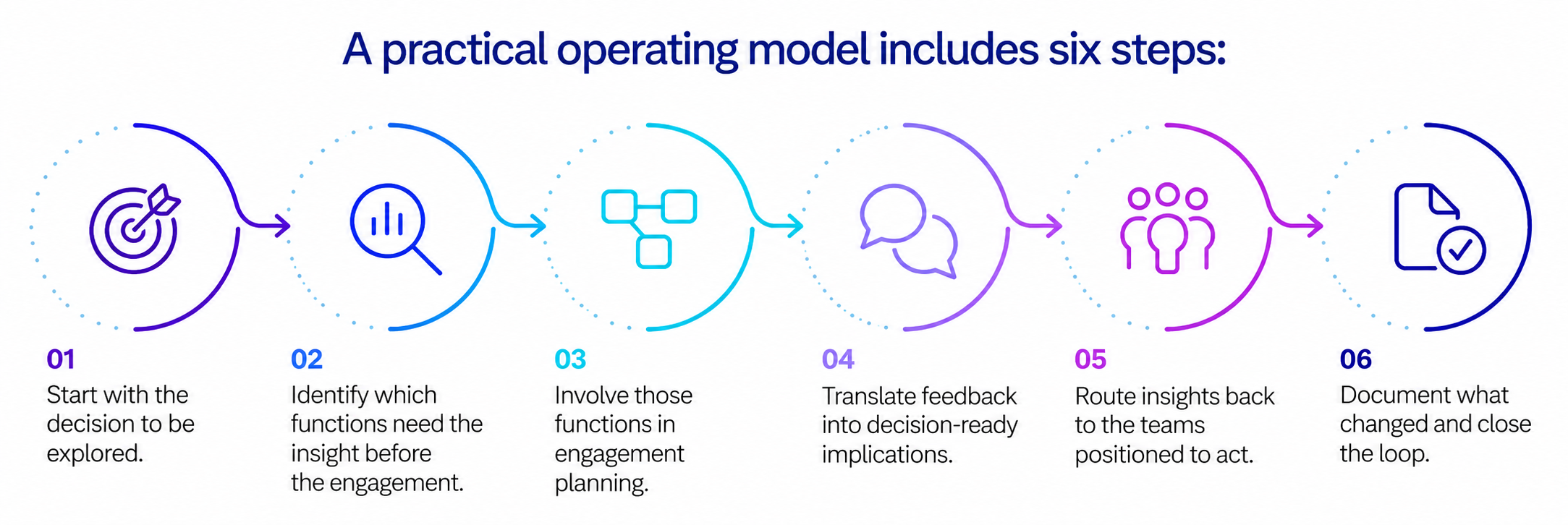
Start with an upcoming launch, relaunch, clinical trial, access strategy, or asset decision. Identify where patient understanding is incomplete and which functions need to be involved. Then agree on how findings will be assessed, acted on, and shared back.
The value becomes visible in the assumptions challenged, barriers identified, materials improved, and decisions informed.
Following an insight through to a response gives organizations a more meaningful measure of engagement than the summary alone.
Download From Patient Voice to Action to explore how patient and advocate insights can reduce decision risk, strengthen cross-functional planning, and build trust across the asset lifecycle.
Explore how patient and advocate insights can help strengthen decisions across development, launch, access, support, and engagement.