Request a Consultation
Our experts can help you reframe what’s possible.

The EU Joint Clinical Assessment (JCA) reshapes how pharmaceutical teams prepare for market access. As all new medicines will undergo assessment by 2030, companies must act early, integrating JCA considerations into clinical planning, evidence strategies, and launch readiness. We help teams anticipate PICO scenarios, align trials with JCA expectations, as well as minimize launch risk through strategic planning and cross-functional collaboration.
The EU Joint Clinical Assessment (JCA) is part of the EU Health Technology Assessment Regulation (EU 2021/2282), designed to create a single, standardized review of clinical evidence for new medicines across all EU member states (European Commission, 2025). It focuses on clinical effectiveness, safety, and comparative outcomes, replacing the need for multiple national assessments of the same data.
The EU will implement the JCA in stages, beginning in 2025 for oncology and advanced therapy medicinal products (ATMPs), expanding in 2028 to orphan and other innovative medicines, and applying to all new medicines by 2030 (European Commission, 2025).
With a significant procedural shift, it defines the baseline clinical evidence required for EU market access and influences the pace and consistency of national reimbursement decisions.
Market Access Dependence: Without JCA compliance, access to EU markets could be delayed or denied.
Early Evidence Planning: Market access planning should begin during strategic phases, ideally before pivotal trial designs are finalized.
Comparative Value Assessment: Preparing for indirect treatment comparisons early will be essential to demonstrate relative benefit.
Cross-Functional Coordination: Align clinical, regulatory, market access, and HEOR efforts so JCA expectations are built into every stage of development.
Competitive Advantage: Teams that plan early and embed JCA requirements into trial design will be better positioned for timely and consistent reimbursement decisions.
JCA assessments follow the Population, Intervention, Comparator, and Outcomes (PICO) framework. Pharma teams need to:
This early, iterative approach ensures trials generate data aligned with anticipated JCA requirements and reduces the need for adjustments late in development.
Embedding JCA requirements into clinical development ensures pivotal studies produce evidence that aligns with anticipated assessment needs. Companies should:
Incorporate JCA considerations early in trial design so studies are structured around expected PICO elements.
Participate in joint scientific consultations to confirm endpoints and comparators meet HTA expectations.
Plan for indirect treatment comparisons (ITCs) through early feasibility reviews and protocol designs that enable reliable cross-trial analyses.
Select comparators consistent with current standards of care across key EU markets.
Success requires collaboration across functions:
Ensure JCA requirements are integrated in all decisions and deliverables.
The first wave of JCA requirements begins in 2025 for oncology and advanced therapy medicinal products (ATMPs), expanding to all medicines by 2030. Pharma teams must:
Align planning across EMA and EU-HTA milestones to keep regulatory and assessment activities moving in step.
Build in adequate lead time for dossier development, as teams must typically submit JCA materials several weeks before the EMA CHMP opinion.
Anticipate quick review cycles and internal workload peaks, ensuring teams are prepared to respond efficiently to requests.
Maintain close coordination between global, regional, and local teams and incorporate JCA outcomes smoothly into national HTA and reimbursement submissions.
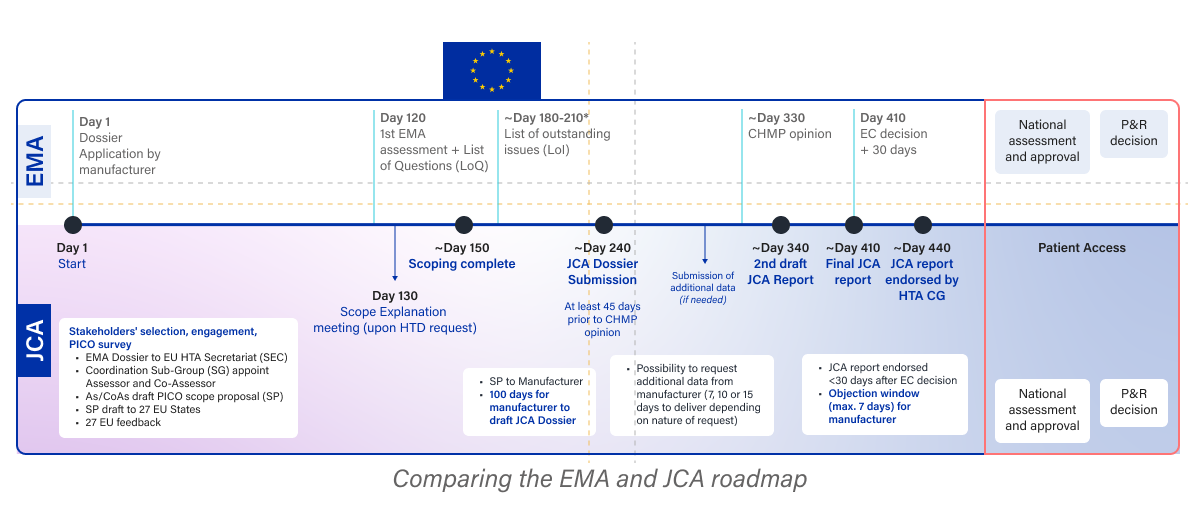
Navigating JCA is complex. Partnering with specialist experts can help companies:
Simulate potential PICO scenarios and anticipate EU market variations through integrated strategic planning.
Align global, regional, and local perspectives so evidence strategies and launch plans remain connected across markets.
Support feasibility assessments, dossier preparation, and methodological alignment and meet evolving JCA standards.
Facilitate communication and coordination across internal and external stakeholders and streamline every stage of the JCA process.
Preparing for JCA means managing uncertainty in European comparator choices and outcome measures. This is where PICO Predict comes in.
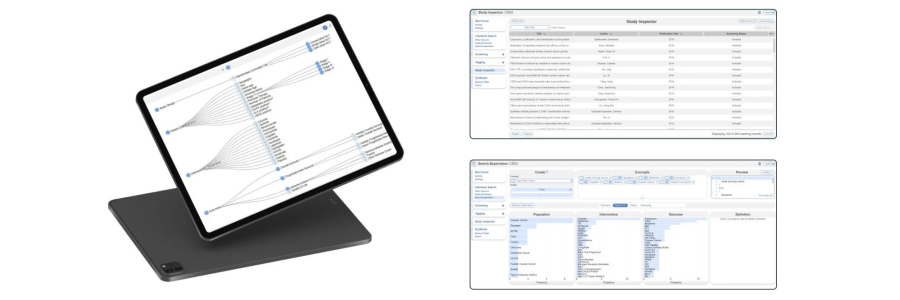
Custom-tailored scenario modeling: AI predicts and validates PICO configurations for specific assets and markets.
Live evidence-synthesis updates: Systematic literature reviews (SLRs) and data-generation plans can be refreshed as the treatment landscape changes.
Seamless integration into submissions: AI-driven outputs feed directly into JCA evidence packages, ensuring alignment across regulatory, market access, and HEOR teams.
As a result, by integrating tools like PICO Predict early, pharma teams can design trials more confidently, anticipate country-specific divergences, and accelerate their path to positive JCA outcomes.
JCA is not just a regulatory checkbox; it is a strategic shift in how pharma companies must plan for EU launches. By anticipating PICO, aligning trials, and collaborating across functions, companies can support earlier access, smoother reimbursement, and stronger competitive positioning.
Acumetis helps life sciences leaders reframe what’s possible by connecting evidence, access, clinical, regulatory, and commercial expertise across the asset lifecycle. Our teams can support you in building a tailored JCA readiness roadmap, strengthening evidence strategies, and reducing launch risk in a more complex EU access landscape.
Is your team JCA ready? Connect with Acumetis experts to build a tailored JCA readiness roadmap and reduce launch risk.
Our experts can help you reframe what’s possible.
"*" indicates required fields