Category dynamics in market access triggered by Most Favored Nation

“A U.S.-only commercial strategy will protect our price and profits from the pressure of MFN.”
Prevailing truth or self-deception?
Most Favored Nation (MFN) pricing fundamentally changes the economics of pharmaceutical commercialization by linking U.S. pricing to international pricing decisions.
The strategic implication extends beyond a manufacturer’s own pricing decisions. In a post-MFN world, determining where and when to launch is a function not only of a company’s individual price-referencing exposure, but also of category-level price-referencing risk created by competitors. At Acumetis, we describe this shift as a transition from market-by-market optimization toward global system optimization, where ex-U.S. launch decisions in a category directly influence U.S. economics and vice versa, merging two previously disparate pricing worlds together.
A working hypothesis for your consideration in this paper is that a manufacturer that ignores competitor launch behavior may discover that its U.S. price has become anchored by rival products commercialized abroad; thus category simulation is critical.
Game theory is the analytical framework best suited to navigate this new reality. Under MFN, manufacturers are no longer operating in distinct pricing worlds (U.S. vs ex-U.S.) where they have primary agency over launch price; today they are participating in an interconnected strategic ecosystem where the launch timing, market entry sequence, and pricing decisions of one competitor, even in a distant market, can materially influence the pricing and the economics of all others. This risk is not only present at launch, but throughout the product life cycle.
How do you account for this category-level risk? →
Pharmaceutical Competition & Category Pricing Dynamics
In competitive pharmaceutical categories, a multifactorial utilization environment is in play whereby patients demand, physicians prescribe and payers reimburse based on product price and perceived clinical value.
Cross-price elasticity measures how demand for one therapy changes when the price of a competing therapy changes. The magnitude of this relationship depends on how interchangeable the products are perceived to be by payers, prescribers, and patients.
Two key scenarios illustrate this dynamic:
1. Clinically Comparable Therapies (High Cross-Price Elasticity):
When two therapies are viewed as broadly equivalent in efficacy, safety, and patient experience, they function as close substitutes. In these situations, payers are highly responsive to relative pricing differences, and a price reduction by one manufacturer can result in meaningful shifts in formulary preference, market access, and patient volume away from competing products. The biosimilar marketplace is a very clear example of this dynamic at play.
2. Differentiated Therapies (Lower Cross-Price Elasticity):
When one therapy offers meaningful clinical advantages—such as superior efficacy, improved safety, greater convenience, or better patient outcomes—demand becomes less sensitive to competitor pricing. Payers still consider price as a key value driver, but the question arises: is the difference in those advantages large enough to warrant a price premium? The stronger the perceived advantages of the superior good, the greater pricing power and the less sensitive to price buyers are.
An example of this dynamic in the industry today can be found in the two latest generation GLP-1 products indicated for obesity: Ozempic (semaglutide) and Mounjaro (tirzepatide). The products have substantially similar product profiles, sharing a tight category pricing corridor (e.g. Ozempic WAC: $1,027.51; Mounjaro WAC: $1,112.60) and high cross price elasticity of demand. Pricing decisions made by one GLP-1 manufacturer can and will influence utilization patterns and market share across the entire category, creating a highly interconnected competitive environment.
In a post-MFN environment, the impact extends globally. If one manufacturer adopts an aggressive global access strategy that establishes lower benchmark prices in reference markets, competitors may eventually experience pricing pressure in the category even if they never launched their specific product outside of the USA.
Take home: Prices of substantially similar assets tend to move together over time; MFN extends that reach globally and thus category dynamics in MFN become inseparable from asset-level strategy (Exhibit A).
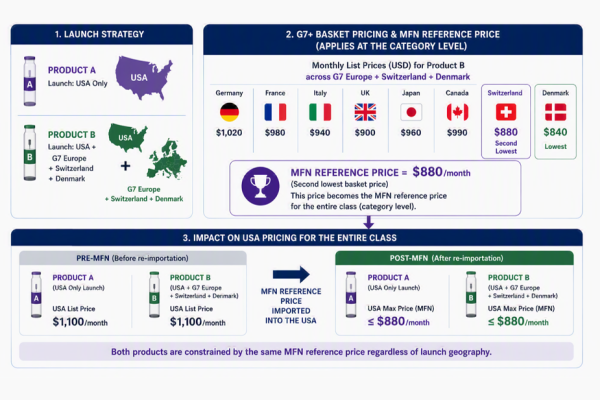
Exhibit A: MFN category dynamics in a hypothetical class of therapies with substantially similar product profiles and high cross price elasticity of demand. Product A/B labels in this illustrative exhibit are independent of the Manufacturer A/B case study below.
The increased global influence of HTA
Global markets contain single, dominant purchasers capable of exerting substantial influence over price and access conditions. European health technology assessment (HTA) systems are classic examples of organizations whose appraisals inform pricing in local markets. Agencies such as NICE in the United Kingdom, G-BA in Germany, HAS in France, and AIFA in Italy negotiate or influence pricing on behalf of national health systems. These organizations evaluate comparative value, determine reimbursement eligibility, and make determinations concerning what is economically justifiable pricing. Similarly, traditional Medicare functions as a dominant purchaser for significant segments of the U.S. population and increasingly influences market-wide access decisions.
Commercial insurance and Medicare Advantage plans operate within a more competitive marketplace, yet MFN causes these entities to indirectly reference different archetypes (e.g. HTA). If U.S. launch prices become linked to international benchmark markets, then decisions made by centralized HTA bodies in Europe ultimately affect commercial payer economics in the United States. EU Joint Clinical Assessment also standardizes clinical weakness, which is the cardinal reference material in downstream HTA appraisals. Taken together, pan European appraisal process plays a massive role in a post MFN world, as these single payer systems have gained tremendous influence beyond their domestic boundaries (Exhibit B1).
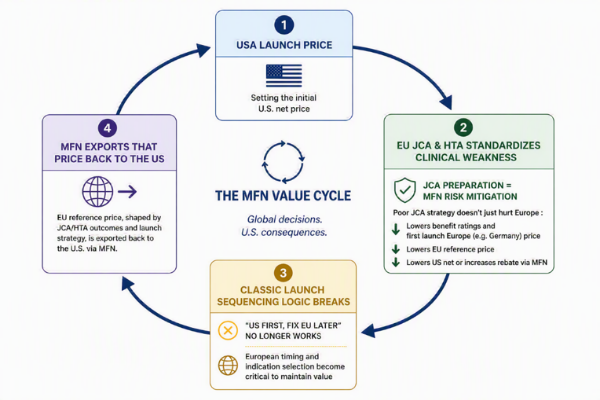
Exhibit B1: The MFN Value Cycle is globalized
Take home: Commercial strategy requires understanding how decisions made by global HTA agencies cascade throughout the global pricing ecosystem.
Game Theory: Two Manufacturers in a Post-MFN World
Applying what we’ve discussed above concerning interlinked manufacturers and empowered central payers to a competitive scenario let us consider the following:
- Two manufacturers (manufacturer A + B) launching specialty therapies independently launch their products at an identical U.S. list price of $300,000 annually.
- Both products target a disease affecting 0.005% of the population.
- Over ten years, each manufacturer gradually expands utilization (5%, 25%, 50%, 75%, 95%, 100%…) until each reaches 20% market share in the target market.
Exhibit C: US Only Launch for Both Manufacturers (as perfect substitutes)
In the first scenario, both manufacturers launch only in the United States.
If Product A and Product B are perfect substitutes and each company maintains price (due to a highly elastic pricing dynamic) then the commercial opportunity is equivalent at $13.2B over a 10-year horizon with neither firm triggering an MFN reference price over the horizon.
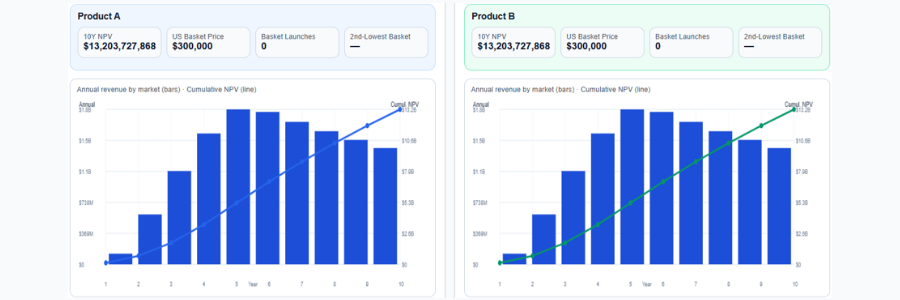
Exhibit C: Perfect substitutes in a category launching solely in the USA
Exhibit D: Manufacturer A goes global; Manufacturer B remains US-only
At this point, with both products launched in the US only, it is rational for each manufacturer to launch globally if they believe that their competition will remain solely in the USA. The dominant strategy for each manufacturer is to launch in a European market left vacant by their competition. This is a game theory decision making process (Exhibit D-1).
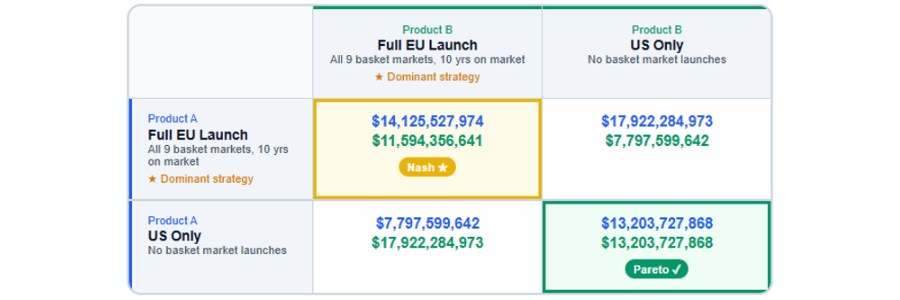
Exhibit D-1: Manufacturer A’s dominant strategy is to enter Europe ($17.9B opp vs $13.2B opp) if they believe their competition will entirely abstain from the continent.
For example, let’s assume the following actions transpire following in the game theory exercise:
- Manufacturer A projects that Manufacturer B will maintain a US or a US+1 launch strategy for their product B
- Manufacturer A sees the opportunity to increase net present value (NPV) by launching their Product A in Europe ($17.9B vs $13.2B opportunity)
- Manufacturer A launches Product A across the United States, Canada, United Kingdom, France, Germany, Italy, Japan, Switzerland, and Denmark.
- Over several years, country-specific negotiated prices emerge for Product A, ranging from approximately $110,000 to $220,000 after discounts relative to the $300,000 U.S. launch price.
- Manufacturer B remains in a US-only strategy to “protect” their U.S. price
- The total NPV for Manufacturer A increases to $17.9B; Manufacturer B’s NPV decreases to $7.8B (see Exhibit D-2)
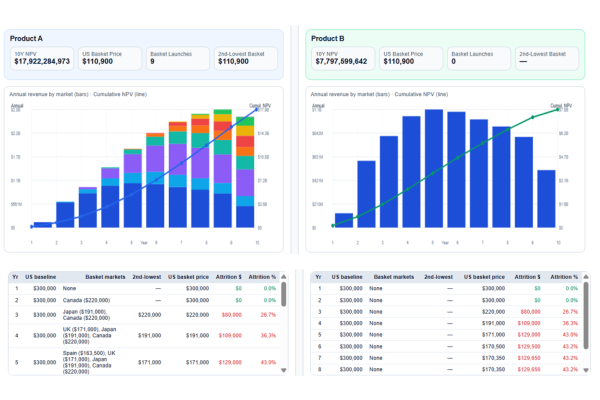
Exhibit D-2: Manufacturer A launches in Europe, increasing NPV to $17.9B; Manufacturer B remains in the U.S. and sees their NPV shrink to $7.8B.
At first glance, Manufacturer A appears disadvantaged due to the triggering of MFN reference pricing and the corresponding gross to net erosion of price in the U.S. from the global activities. However, manufacturer A simultaneously captures substantial incremental volume from multiple ex-U.S. markets. The reduction in U.S. unit revenue is offset, at least partially, by global patient access and broader geographic market penetration.
Manufacturer B faces a different and more paralyzing challenge. Because Product B competes within the same therapeutic category, payers begin benchmarking its price relative to Product A. Even without an international launch and imposed MFN reference price reimported to their specific brand/product, Manufacturer B becomes exposed to category pricing pressure. Payers question why a clinically similar therapy should command twice the price of an MFN-constrained competitor. Formulary negotiations intensify. Net pricing erodes.
As a result, manufacturer B experiences many of the pricing disadvantages associated with MFN but receives none of the volume benefits associated with global commercialization.
Critically – Manufacturer B also risks becoming a price taker in their key US market. They are subject to the global machinations of manufacturer A, suffering attrition on their gross to net price in the U.S. in line with their competitor’s MFN reimported US price beginning in year 3 ($220,000 reference price reimported to the category), falling further to $191,000 by year 4, and ultimately reaching $110,900 by year 10 as Manufacturer A’s basket expands to additional markets.
At this point, reassessing the game theory situation, it becomes rational for Manufacturer B to also enter Europe, increasing their NPV from $7.8B to $11.6B (Exhibit D-3). As second movers, they will not re-capture all the time or market lost due to their initial EU abstention, but they will at least compete for the market (versus ceding the entire thing to their competition AND taking the price attrition in the USA). This is the Nash Equilibrium and best response for the two manufacturers – neither can improve their product’s NPV further and has no incentive to change their strategy.
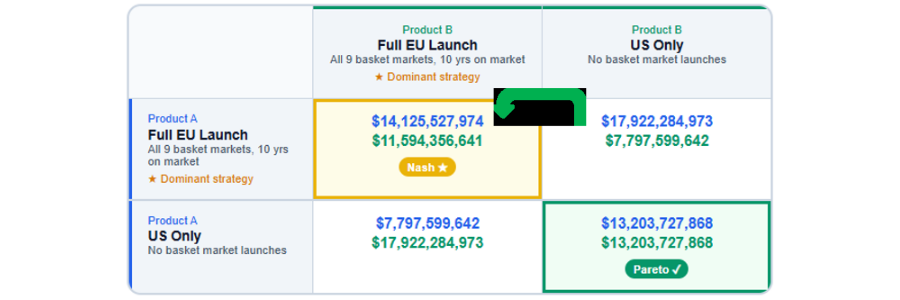
Exhibit D-3: Game theory strategy plane following Manufacturer A launching in global markets compels Manufacturer B to compete in global markets.
Take homes: Manufacturer A may be economically rational even when it generates U.S. gross-to-net erosion because the manufacturer receives compensatory volume from international markets.
Manufacturer B, by contrast, may suffer category-level price anchoring without capturing any ex-U.S. revenue. They also become price takers with very little leverage except to meet their competition (reactively) in the marketplace. What initially appears to be a defensive U.S.-only strategy may ultimately prove less attractive than an integrated global strategy.
Conclusion: Category Dynamics Prevail and MFN Simulation Predicts
The evolving MFN environment requires manufacturers to move beyond static launch planning and embrace dynamic scenario analysis. The central question is no longer whether global launch creates U.S. pricing exposure. Rather, the question is whether competitors will create that exposure first. Some companies have more leverage than others, based on size, scope, and the incentives driving financial performance in the market.
Acumetis has developed the Most Favored Nation (MFN) Simulator (Exhibit E) – an advanced, decision-grade modeling platform designed to quantify the net present value (NPV) of alternative global pricing and market access strategies in an evolving MFN environment.
The simulator also models competitor launch decisions, incorporates cross-price elasticity of demand, and applies game-theory principles to project rational next-mover behavior and equilibrium outcomes. These concepts align closely with Acumetis MFN modeling capabilities focused on forecasting how international referencing cascades through both client and competitor strategy.
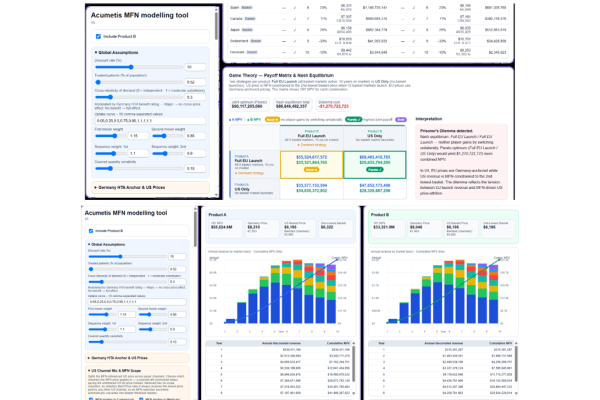
Exhibit E: Acumetis MFN Simulator
In a post-MFN marketplace, strategic advantage will belong not to companies that merely forecast their own price erosion, but to those capable of anticipating how competitors, payers, and governments may interact within an increasingly interconnected global pricing ecosystem. The future of market access is therefore not simply about your pricing or access decisions; it is about understanding the geographic and pricing strategies employed by independent entities across the entire category.
Meet the Experts:

Karl Freemyer
FAQs on Most Favored Nation (MFN) pricing
1. How does Most Favored Nation (MFN) pricing affect pharmaceutical market access?
2. Why are category dynamics important under Most Favored Nation (MFN)?
3. How can game theory improve global launch strategy under MFN?