How the obesity market evolution is reshaping payer strategies and forecasts

Doctor showing patient something on tablet

The obesity market is entering a pivotal stage. Scientific breakthroughs, payer policy reform, and shifting patient expectations are transforming the development, coverage, and delivery of therapies.

While innovation expands treatment possibilities, escalating costs force payers to balance affordability with long-term value. Success now depends on how effectively manufacturers align evidence generation, economic modeling, and contracting strategies with the needs of both payers and patients.

 What’s Changing in Obesity Treatment

  • Therapeutic Breakthroughs: GLP-1 receptor agonists and other emerging treatments are delivering outcomes once thought out of reach—with next-generation therapies achieving 15–20% weight loss and setting new efficacy benchmarks.
  • Growing Demand: As coverage expands, obesity treatment is shifting to essential care. It is now seen as a driver of long-term health improvement and disease prevention.
  • Market Competition: With over 140 agents in development, differentiation depends on clinical outcomes, convenience, and value storytelling

 How payers are responding

  • Value Assessment: Coverage decisions emphasize durable outcomes and the potential to reduce costs associated with obesity-related conditions. Growing clinical evidence, along with the Centers for Medicare and Medicaid Services’ plan to expand coverage, reaffirms the importance of obesity treatment as a critical tool for preventing chronic disease and reducing long-term healthcare costs.
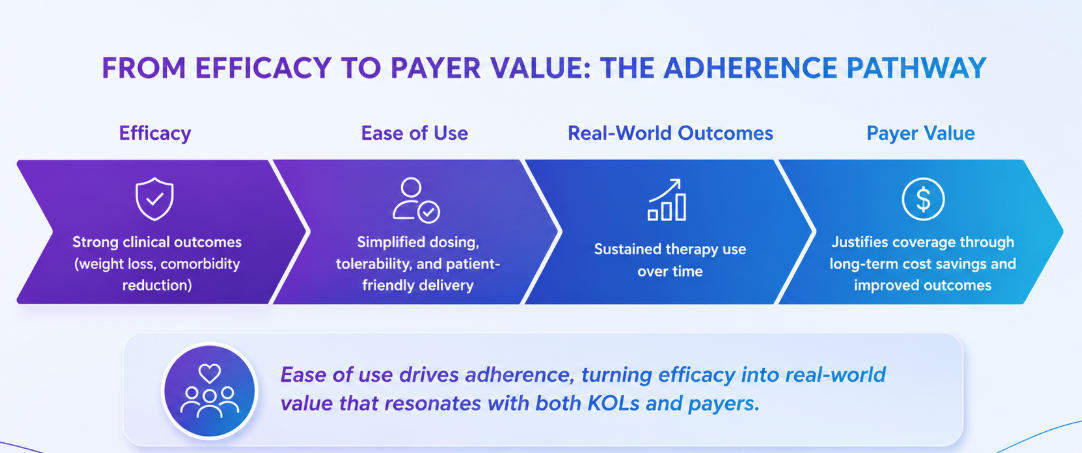
  • Access & Adherence: Ease of use, patient adherence, and durability of outcomes are now critical factors in access decisions. Therapies that reduce injection burden, improve tolerability, and demonstrate sustained patient engagement are more likely to secure favorable coverage and formulary placement.

    Why the market outlook is shifting

    Patient populations treated for obesity are expected to grow as payer coverage expands, reflecting a broader acceptance of obesity therapies and an increased focus on clinical outcomes. Market differentiation will depend on demonstrated real-world effectiveness, patient experience, and the ability to provide measurable value. Long-term sustainability will favor therapies that deliver both meaningful health impact and economic benefit, ensuring continued access and adoption across the healthcare landscape.

    In parallel, the rise of digital health and telehealth platforms is expanding how patients learn about and access obesity therapies. These emerging pathways are introducing early elements of direct-to-patient (DTP) connectivity, signaling a gradual shift toward more integrated, patient-centric access models.

    Sustained market success will favor therapies that deliver meaningful health impact, proven economic value, and a superior patient experience across both payer-driven and patient-connected touchpoints.

    Key takeaways

    1. Collect and communicate robust real-world evidence to support payer decision-making.
    2. Clearly articulate the value proposition, emphasizing clinical outcomes and cost-effectiveness.
    3. Optimize the patient experience to support adherence and long-term success.
    4. Engage payers early to align evidence, contracting, and access strategies.
    5. Monitor the rise of digital and patient-driven access models that signal the early shift toward direct-to-patient (DTP) care.

    Leveraging Acumetis expertise

    Acumetis helps life sciences organizations see differently and decide confidently in a rapidly evolving obesity market. By connecting medical, access, commercial, insights, and patient strategy across the asset lifecycle, Acumetis supports manufacturers in reframing complex market challenges into clear, actionable strategies.

    Through integrated evidence generation, payer alignment, economic modeling, and patient-centered planning, Acumetis helps organizations demonstrate value, de-risk access decisions, and build strategies that are both imaginative and achievable. This connected approach enables manufacturers to support adoption at scale, strengthen long-term market performance, and deliver better outcomes for patients.

    Download the report

    Access industry insights, benchmarking data, and trends shaping patient services in 2026.

    Learn more

    "*" indicates required fields

    Learn More

    Meet the Experts:

    Swathi Rangan
    Swathi Rangan
    Partner, Commercial Strategy Practice Lead

    Swathi excels at leading teams to deliver effective, client-centered commercial solutions. She has worked across large, mid-size, and start-up organizations, with deep expertise in immunology, oncology, cardiometabolic disorders, and rare disease. Her experience spans strategy through implementation, with a focus on data- and insight-driven innovation, including patient support and experience design, digital health partnerships, and go-to-market strategy. She also specializes in market-shaping strategies for complex diseases and has successfully led numerous product launches.

    Anne Boguslavsky
    Anne Boguslavsky
    Senior Consultant, Commercial Strategy

    Anne is a senior consultant at Acumetis and a physician board-certified in internal medicine and obesity medicine. She brings experience across pharmaceutical brand strategy, launch planning, patent expiration, and physician outreach. Anne holds a BA from Dartmouth College and an MD with distinction in research from Cooper Medical School of Rowan University.