Request a Consultation
Our experts can help you reframe what’s possible.

Oncology pipelines have become increasingly rich over the past few years, with a growing mix of advanced biologics, personalized therapies such as ATMPs, more complex injectables, and oral treatments reaching late-stage development and approval. In addition, the recently published National Cancer Plan for England highlights that faster approvals are accompanied by rising expectations for the speed of delivery, scalability, and implementation within the NHS.
As these expectations rise, attention is shifting to what happens after approval, and to the parts of the system that determine how well new therapies can be delivered in routine care.
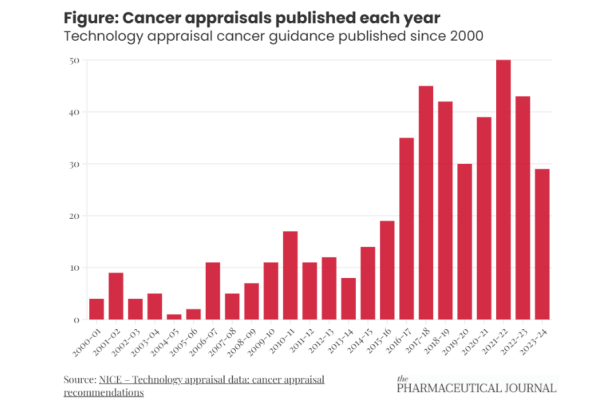
Taken from: The Pharmaceutical Journal, PJ, July 2025
The diversification of oncology innovation has brought with it fundamentally different delivery requirements. Advanced therapies and complex biologics are not simply incremental changes to existing practice; they require new approaches to preparation, handling, monitoring, and governance.
Oncology pharmacy services sit at the center of this shift. What is often less visible outside clinical practice is the extent to which pharmacists are now directly involved in the delivery of oncology care. In many services, oncology pharmacists are trained as independent prescribers within defined tumor groups, working alongside consultants to initiate, adjust, and manage cancer therapies. Pharmacists increasingly lead oral chemotherapy services and clinics, taking responsibility for patient education, adherence monitoring, and toxicity management, and play a central role in coordinating care across treatment settings.
Alongside this expanded clinical role, specialist pharmacy functions have emerged to support advanced and complex therapies. Dedicated ATMP pharmacy roles now manage intensive screening, logistics, and governance requirements, while rising volumes of complex injectable and sterile products are placing additional pressure on aseptic services, driving changes to infrastructure, workflows, and capacity.
Together, these developments reflect a significant amount of quiet, behind-the-scenes adaptation. Pharmacists have increased workload, governance oversight, and coordination across multidisciplinary teams, supply chains, and care settings – all of which are now integral to making novel oncology treatments deliverable in practice.
HTA approval remains a critical milestone, but it does not, on its own, ensure timely or consistent access to treatment. Access increasingly depends on whether services are operationally ready to implement complex new oncology treatments safely and at scale. This reflects a broader shift in access risk, from the point of approval towards the practical realities of delivery.
As a result, pharmacy capability is becoming an important determinant of access timelines. Where services are well prepared, with sufficient capacity, infrastructure, and governance in place, new therapies can be introduced efficiently into routine care. Where capacity is constrained, or where pharmacy capability is still developing, access may be slower or more variable, even when reimbursement decisions are positive.
For manufacturers, this raises an important consideration: is the contribution of pharmacy to delivery realities being explored early enough as part of access planning?
Earlier dialogue with pharmacy services, alongside clinicians, can help surface practical considerations around prescribing pathways, monitoring requirements, and service capacity, supporting smoother implementation once therapies move into routine care. While clinical trial set-up can provide early insight into delivery requirements in specialist centers, many sites that ultimately deliver approved therapies are not research sites and may face different operational challenges in routine practice. Earlier consideration of downstream delivery realities can help identify constraints to implementation, inform evidence generation, and ensure that value narratives align with how care is delivered in practice – not only how it is assessed.
As a result, access planning is increasingly moving upstream. Beyond evidence generation, manufacturers are being encouraged to engage earlier with pharmacy teams, clinicians, and wider system stakeholders, and to support horizon‑scanning activities that give both NICE and the NHS visibility of therapies coming down the pipeline in 2-5 years’ time. This earlier insight helps identify service requirements, workforce implications and pathway changes in advance — improving the likelihood that approval translates into timely patient access.
As oncology innovation continues to evolve, understanding what happens behind the scenes will become increasingly important on the road to access. At Acumetis, our Global Value and Access team includes consultants with real-world experience of oncology care delivery, including time spent working as pharmacists and alongside clinical teams. This perspective allows us to bring practical delivery insight into access strategy- whether supporting core value narratives, HTA and JCA planning, or implementation readiness- helping ensure that access strategies are grounded not only in evidence, but in how oncology care is delivered in practice.
If you would like to discuss this further, please get in touch at: olivia.cottom@acumetisglobal.com or contact@acumetisglobal.com

Olivia Cottom
Manager
Olivia is a healthcare consulting manager specializing in market access, with over five years of experience supporting pharmaceutical clients, particularly in oncology and hematology, and prior clinical experience as a pharmacist in the NHS. She has led global and regional projects across Europe, Asia-Pacific, and Latin America focused on access strategy, reimbursement, and product differentiation. She brings expertise in HTA, value assessment, and value communication, grounded in real-world clinical experience.
Our experts can help you reframe what’s possible.
"*" indicates required fields