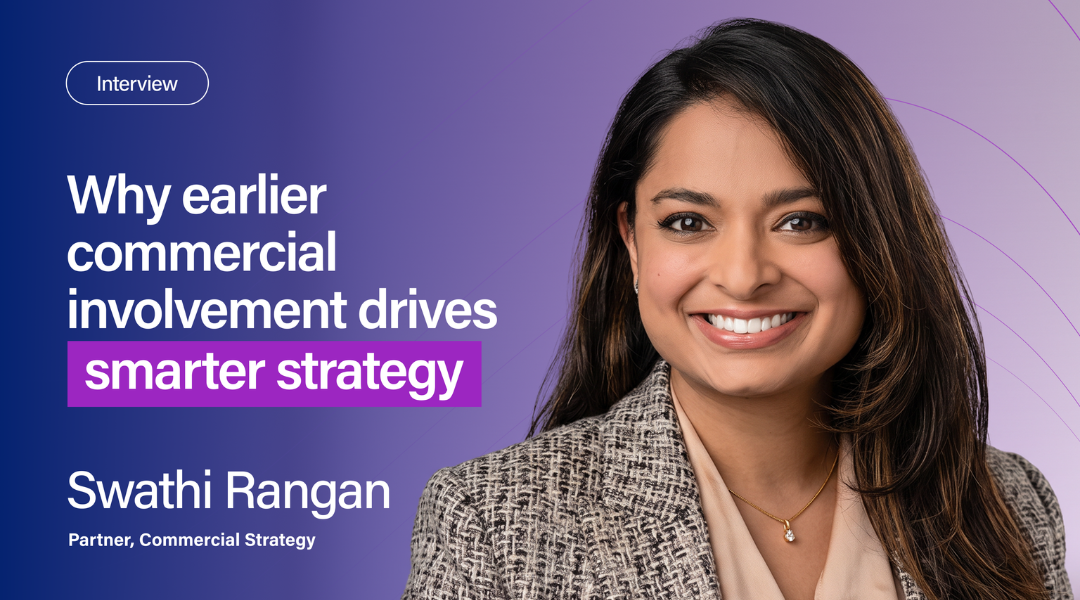
Why earlier commercial involvement drives smarter strategy

A brand plan should not be something teams create once and defend indefinitely. As Swathi Rangan explains, commercial strategy should be a living, iterative framework, with decision triggers, milestones, and scenarios built in upfront so teams can adapt as conditions change.

In this Fierce Pharma Executive Interview, Swathi Rangan, Partner and Commercial Strategy Practice Lead at Acumetis, discusses how teams can distinguish meaningful market signals from noise, pressure-test assumptions, and determine when change requires a strategic pivot versus a tactical response. She also explores why commercial needs a seat at the table earlier, when decisions around evidence, endpoints, positioning, and future launch strategy are still being shaped.

The conversation extends through lifecycle planning, including how market development differs across emerging and crowded categories and why teams should plan for multiple pathways across the life of an asset.

Watch the full interview to explore how earlier commercial involvement and adaptive planning can support more proactive, connected decision-making.

Watch the interview →   Why earlier commercial involvement drives smarter strategy

Request a Consultation

Our experts can help you reframe what’s possible. 
Let's Talk

"*" indicates required fields

Learn More

Meet the Experts:

Swathi Rangan
Swathi Rangan
Partner, Commercial Strategy Practice Lead

Swathi excels at leading teams to deliver effective, client-centered commercial solutions. She has worked across large, mid-size, and start-up organizations, with deep expertise in immunology, oncology, cardiometabolic disorders, and rare disease. Her experience spans strategy through implementation, with a focus on data- and insight-driven innovation, including patient support and experience design, digital health partnerships, and go-to-market strategy. She also specializes in market-shaping strategies for complex diseases and has successfully led numerous product launches.

1. Why should commercial teams be involved earlier in drug development?

Earlier involvement gives commercial teams a seat at the table while decisions around evidence generation, endpoints, patient populations, positioning, and launch strategy can still be influenced.

2. How can pharma teams build a more adaptive commercial strategy?

Teams can treat the brand plan as a living, iterative framework by building in decision triggers, milestones, and scenario plans that help guide how the strategy should evolve as market conditions change.

3. How can commercial teams distinguish market signals from noise?

Swathi recommends pressure-testing assumptions on a regular cadence and validating signals across multiple channels before determining whether new information warrants a strategic change or a more tactical response.