Request a Consultation
Our experts can help you reframe what’s possible.

How site of care strategy changes when the patient journey spans multiple settings, channels, and decision-makers.
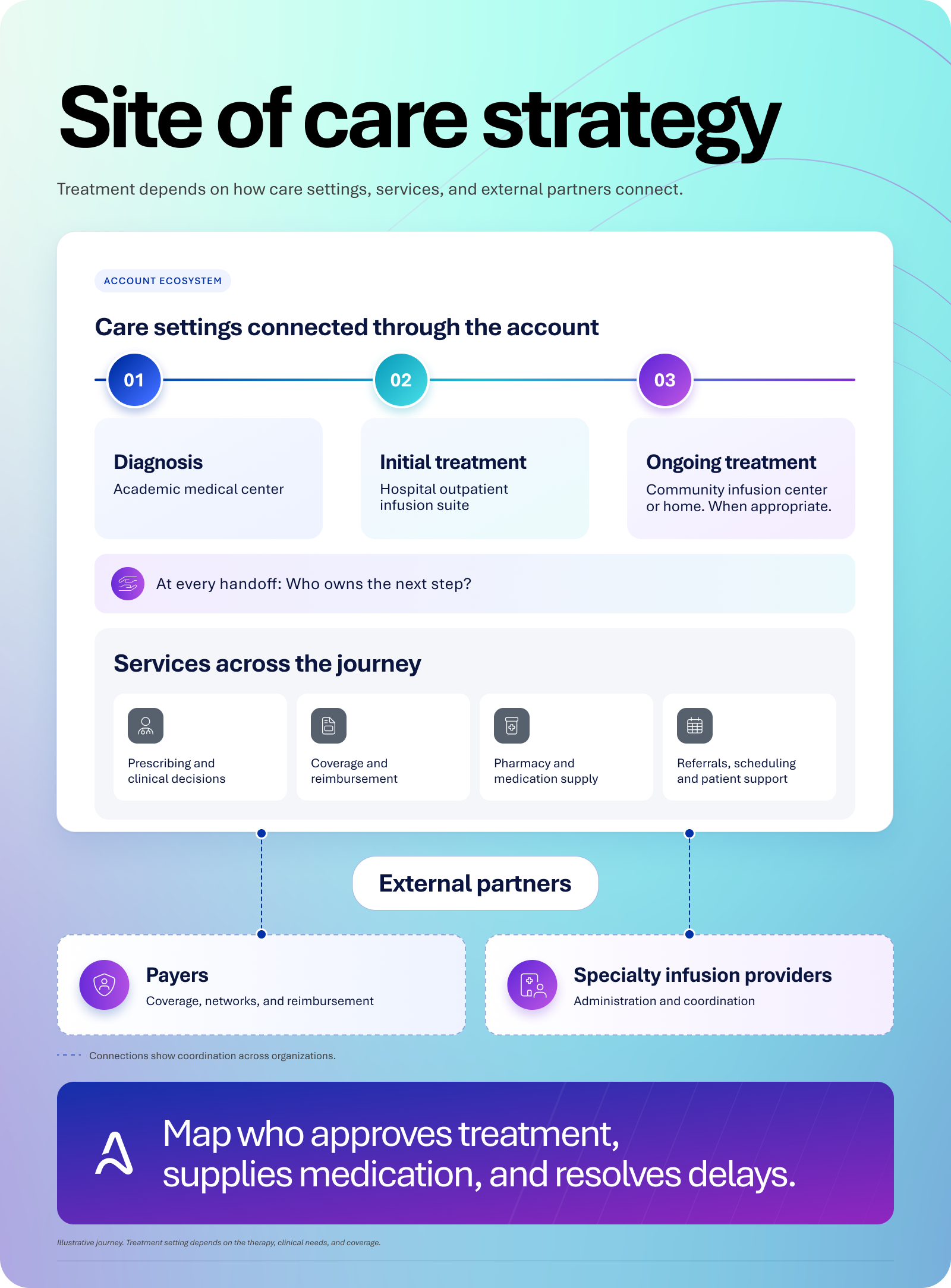
Consider a patient diagnosed at an academic medical center who receives initial treatment in a hospital outpatient department. Maintenance treatment may later move to a community infusion center or, when appropriate, the home.
A health system specialty pharmacy may supply the medication, while the insurer determines the covered setting. A separate provider may coordinate administration. Each transition introduces another decision, another handoff, and another potential delay.
A patient journey map built around a single treatment pathway can miss these transitions. When responsibility passes between care entities, patients may face delays that no single team sees or owns.
An effective site of care strategy connects where treatment happens with how it is prescribed, covered, supplied, and supported.
For commercial and patient access teams, the account ecosystem is where those decisions come together. Understanding that ecosystem means knowing who approves treatment, who supplies it, and who resolves problems when patients cannot move forward.
When mapping the patient experience, commercial and patient access teams need to consider each factor individually and together. A change in one can affect the rest:
A change in one element can require changes elsewhere. A new formulation may introduce a different dispensing partner. Home administration may require another provider, a separate coverage review, and a new process for sharing information.
Perceived simplicity can influence treatment preferences, but fewer visits do not automatically mean an easier experience. Nursing availability, reimbursement, and coordination requirements may create new barriers behind the scenes.
The implications depend on the therapy and the organizations involved. The following examples show why one national model may need several local approaches.
In immunology, intravenous and subcutaneous versions of a biologic, where available, can create different administration and dispensing routes. Commercial and patient access teams need to understand how each option fits the account’s services, pharmacy relationships, and the patient’s coverage.
In oncology, a practice’s ownership can affect who makes formulary, pharmacy, and purchasing decisions. If a community practice joins a health system, those decisions may move to different leaders. Reimbursement and 340B participation may also influence the account’s economics and service planning.
Oral cancer therapies may be supplied through a health system specialty pharmacy. This can make pharmacy leaders important partners in understanding how patients receive medication and ongoing support.
Changes in dispensing models, competing treatments, and reimbursement can affect several therapeutic areas. Commercial and patient access teams need to assess how each change affects local care arrangements.
Medically integrated dispensing adds another consideration. It connects pharmacy services with the treating team, including patient education and medication monitoring. Manufacturers need to understand which services the account manages internally and where outside support is still needed. [1]
In rare disease and gene therapy, patients may need specialist diagnosis, referral to a designated center, travel, and follow-up closer to home. Some gene therapies involve one-time administration. Clinical requirements can limit the available sites, increasing the coordination burden for families.
In cardiometabolic care, direct-to-patient and telehealth models can add new entry points alongside established provider and pharmacy channels. Direct-to-consumer engagement may also influence where patients seek care. Commercial and patient access teams need to understand how these options connect with coverage and ongoing clinical care.
A competitor’s formulation or a payer’s coverage decision can change expectations faster than a manufacturer can update its partner’s arrangements and patient services.
Policy can change the economics of treatment delivery. On November 4, 2026, CMS finalized lower Medicare payments for 340B-acquired drugs in hospital outpatient departments, with an offsetting increase in payments for non-drug outpatient services. [2] This redistribution could prompt integrated delivery networks (IDNs) to reassess how drug margins support their business models and where they invest in treatment capacity. Hospitals outside 340B, including for-profit operators, could benefit from the higher non-drug payments. As accounts prepare for 2027, commercial and patient access teams should identify where these financial pressures could change site-of-care decisions, referral patterns, and patient support needs.
An account ecosystem is the network of prescriber practices, treatment sites, pharmacies, decision-makers, and external partners that shapes how patients receive treatment.
A health system or integrated delivery network may operate hospitals, affiliated practices, infusion centers, and specialty pharmacy services. Its clinical pathways and formulary decisions can affect several parts of care at once. Outside payers and infusion providers may influence treatment without belonging to that organization.
The account map should identify who sets clinical pathways, and makes pharmacy and therapeutics committee decisions, it should also show how patients move between affiliated and external providers. Where a health system also operates a health plan, those coverage relationships matter too.
The account therefore shapes how patients and clinicians act on a treatment decision. Its boundaries matter too. A health system may manage prescribing and dispensing internally while relying on another organization for administration or patient support.
Mapping those relationships shows where responsibilities overlap, or the next step has no clear owner. When ownership is unclear, referral follow-up or coverage checks may be missed. Patients can face longer waits or leave the process before treatment starts.
Patient volume is only part of account prioritization. Commercial teams should also assess how each account influences referrals, dispensing, and treatment delivery. Identify the settings it can support and where external partners are needed.
Two accounts with similar patient populations may need different strategies. One may manage infusion and pharmacy services internally. The other may depend on external partners.
Each function needs to understand the account’s priorities and its own responsibilities. Decisions often span clinical, pharmacy, and operational teams. Separate engagement plans can leave gaps between them.
Key account managers can help coordinate commercial, market access, trade, and patient services activity. Medical Affairs should contribute scientific and clinical insight within its appropriate role. The team needs a shared understanding of the account, with clear responsibilities for each function.
Match distribution and access plans to how each account acquires, dispenses, and bills for treatment. An account using buy-and-bill may need different arrangements from one relying on a specialty pharmacy. Confirm that the dispensing partner, administering provider, and payer requirements work together.
A preferred setting must also be workable. For home infusion, specialty infusion providers may become additional partners outside the health system. Teams need to assess their geographic reach, clinical capabilities, and payer network participation.
Coverage needs its own review. Medicare’s home infusion therapy services benefit has specific eligibility requirements tied to qualifying drugs administered through covered durable medical equipment. Teams must verify coverage for both the medication and the services required to deliver it. [3]
One network model may work for some geographies or patient segments and be impractical for others. Before launch, compare options against patient access, provider capabilities, reimbursement, and coordination needs. Set triggers to revisit the plan as payer policies, networks, or competing treatments change.
Patient services should address the points where responsibility moves between organizations. Who confirms that a referral has been received? Who checks that the dispensing pharmacy can work with the administering provider? Who contacts a patient whose treatment is covered but remains unscheduled?
Acumetis’s work with one manufacturer shows why these handoffs matter. Two weeks after onboarding, two in three patients still had not received their medication. We redesigned fulfillment and patient support, helping the manufacturer shift from a largely self-service retail model to a full-service specialty model better suited to patients’ needs.
After the redesign, the client reported 75% faster delivery of benefits and cost information. [4]
The case involved a channel and support redesign rather than a physical site-of-care change. It shows why manufacturers need to test whether their support arrangements help patients complete each step to treatment.
National averages can conceal local barriers. Where data allows, examine time to treatment, incomplete referrals, and abandonment by account, setting, and channel. Identify where patients wait and which partner can resolve the delay.
That distinction helps teams choose the right response, whether it is a change in partner processes, additional patient support, or a different network arrangement.
Commercial and patient access leaders can start with five questions:
The answers will differ by account and therapeutic area. A useful plan makes those differences visible and identifies which assumptions need continued review.
A brand plan becomes more useful when it reflects the organizations and decisions that determine whether patients receive treatment.
Mapping the account ecosystem shows where treatment depends on another team or organization. Commercial and patient access teams can then validate delivery options and assign responsibility before patients encounter delays. This also gives them a stronger basis for responding when a competitor, payer, or provider changes how care is delivered.
Talk to an Acumetis Commercial Strategy expert about how your site of care and account strategy supports patients across a fragmented treatment journey.
Our experts can help you reframe what’s possible.